















James Kelly for Closets by Design
Two-thirds of Americans play video games every week, according to the Entertainment Software Association. The average age is 37, which means many players are no longer teenagers. That puts consoles, controllers and cables in the family room, a bonus room or a spare bedroom, where none of it was designed to be stored. Ideally, the setup keeps the consoles in open air and puts everything else behind doors.
Closets by Design, a custom closet company with locations across the U.S. and Canada, reviewed the participation data alongside the physical facts of a modern setup to work out how to give gaming hardware a place other than the living room floor.
Key Takeaways
- 72% of players are adults, and 70% of parents play.
- Spare rooms are scarcest in dense coastal metros like Miami and Los Angeles.
- Consoles vent through the sides or top and cannot sit in a closed cabinet.
- Controllers, cases and headsets can go behind solid doors.
- Some setups end up hybrid: consoles on an open shelf, the rest hidden.
Who plays, and how has that changed?
According to the Entertainment Software Association, 72% of players are adults, and 70% of parents play. More details on the current state of gaming are shown below.
| Measure | Figure | Source |
|---|---|---|
| Americans who play at least one hour a week | 212.3 million (67%) | ESA 2026 |
| Average age of a player | 37, up from 29 about two decades ago | ESA 2026 |
| Players who are adults (18+) | 72% | ESA 2026 |
| Adults who play weekly | 60% | ESA 2025 |
| Parents who play | 70% | ESA 2025 |
| Generation Alpha (ages 5-12) who play weekly | 83% | ESA 2025 |
| Boomers (ages 61-79) who play weekly | Nearly half | ESA 2025 |
| Players who play with others weekly | 55% | ESA 2025 |
Where does the setup go?

The extra room is more likely to exist in some regions than others. Extra bedrooms are most common in the Mountain West and South and scarcest in dense coastal metros, according to a Realtor.com analysis of Census data, with Ogden, Utah, at 12.2% of bedrooms and Miami at 5.9%. In a larger house, you can turn an extra room into a gaming or hobby room where the gaming setup gets its own wall. In a Los Angeles or New York household, it likely shares the living room with the television it is plugged into, which makes the storage question a design question for the main room.
What does a gaming storage spec look like?
The hardware is specific, and a cabinet built for a cable box will not hold it. The chart below shows approximate dimensions from the manufacturers' current product pages.
| Item | Approximate size | Storage note |
|---|---|---|
| PlayStation 5 (slim model) | About 14 x 9 x 4 inches horizontal | Needs open air on the sides and back; not a closed cabinet |
| Xbox Series X | About 6 x 6 x 12 inches | Vents through the top; cannot sit under a shelf that touches it |
| Nintendo Switch 2 dock | About 7 x 4 x 2 inches | Small, but the dock and its cable stay out; the handheld needs a charging spot |
| Controllers, multi-platform household | 4 to 8 | Each with a charging cable or dock; a drawer with a power strip or a charging shelf |
| Headsets | 1 to 4 | Hooks or a headset stand; they do not stack |
| Physical games | 20 to 100 cases | Standard DVD-depth shelf, about 6 inches deep |
| Cables | HDMI, power, USB-C, Ethernet, per device | A labeled channel or raceway behind the unit; one power strip per shelf |
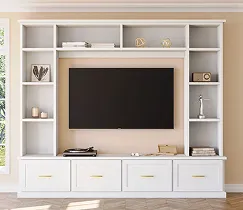
Clearance is a design requirement. Console manuals ask for several inches of open space around the vents, and a closed cabinet door turns a shelf into an oven. If the console goes behind a door, the door needs a vent panel or mesh, and the back of the cabinet needs to be open. Everything that does not generate heat, such as controllers, cases, headsets and the cable surplus, can go behind a solid door. A well-designed custom entertainment center can provide the perfect platform for all your electronic fun needs.
Display or hidden?
| On display | Hidden | |
|---|---|---|
| Best for | Rooms where the setup is the point: bonus room, den, basement | Living rooms and bedrooms that serve other uses |
| Console placement | Open shelf at eye level with the TV, vents clear | Vented cabinet section, back open, door with mesh or slats |
| Controllers | Charging dock on the shelf, visible | Drawer with a power strip, or a pull-out charging tray |
| Cables | Managed but visible; color-matched to the wall | Raceway inside the cabinet, one exit point to the TV |
| Games and accessories | Spine-out shelving as decor | Closed drawers, sorted by platform |
| What fails | Dust, and a wall that looks like a store | Heat, and a cabinet that is hard to reach into |
Often, a hybrid approach is the answer: the consoles on an open, vented shelf and everything else behind doors.
This story was produced by Closets by Design and reviewed and distributed by Stacker.