























James Kelly for Closets by Design
About two-thirds of the clothing Americans get rid of ends up in a landfill, and less than 15% is recycled, according to 2018 data from the U.S. Environmental Protection Agency. The bag you drop at a thrift store does better: what sells is sold, and most of the rest becomes wiping cloths or fiber instead of trash. Two states now regulate what you can throw out, and a few habits at the closet make a bigger share of a clean-out useful to someone.
Closets by Design, a national custom closet design and installation company, reviewed federal and state data to map where a closet clean-out actually goes.
Key Takeaways
- Goodwill sends unsold clothing to outlets, then auctions, then recyclers.
- About 5% of Goodwill San Francisco's clothing ends up in landfills.
- Massachusetts bans textiles from the trash; California's producer program starts in 2026.
- Stained, torn or single items go to textile recycling, not the thrift bin.
- Only moldy or oil-soaked textiles belong in the trash.
How much clothing ends up in the landfill?
The Environmental Protection Agency's textile category covers clothing and footwear plus sheets, towels and the fabric in furniture and carpet. In 2018 the agency counted 2.5 million tons recycled, 3.2 million tons combusted with energy recovery and 11.3 million tons landfilled, according to its materials data. Textiles were 7.7% of everything landfilled that year.
| Destination, 2018 | Tons | Share of textiles generated |
|---|---|---|
| Recycled | 2.5 million | 14.7% |
| Combusted with energy recovery | 3.2 million | 18.8% |
| Landfilled | 11.3 million | 66.5% |
| Total generated | 17 million | 100% |
Source: EPA, Facts and Figures about Materials, Waste and Recycling, textiles. Shares calculated from EPA tonnage; the EPA notes that clothing entering the reuse market is not counted in the generation figure.
What happens to clothes after you donate them?
A donated bag is sorted first for what will sell. At Goodwill, items that are clean enough to sell and do not move within about four weeks are sent to by-the-pound outlet stores, then to bulk auctions, and finally to textile recyclers, according to Waste Dive. Goodwill's CEO, Steve Preston, told an audience at George Washington University in March 2025 that trashing unsold goods is the last option, in part because "landfills are expensive," according to a university recap of the talk. Goodwill estimates that of the salvage it sells on, about a third is recycled into rags, 20% is shredded for industrial use and 45% is resold, mostly overseas.
In 2019, Goodwill of San Francisco's chief executive told KQED the organization sends about 5% of its clothing to the landfill.
A donation bin is not a trash can with a better conscience, but it is also not a boutique. Anything stained, torn or missing a button is going to the rag and fiber stream no matter where you drop it. The Connecticut Department of Energy and Environmental Protection notes that clothing not in good condition is reused as rags or recycled into fiber, which is a legitimate second life, as long as the item is clean and dry.
Which states regulate textile disposal?
Two states have moved from encouragement to rules, and two more are debating bills.
| State | Policy | Status |
|---|---|---|
| California | SB 707, the Responsible Textile Recovery Act of 2024: producers of apparel and textiles must fund and run collection, repair, reuse and recycling through a single producer responsibility organization | Signed September 2024. CalRecycle selected Landbell USA as the operator Feb. 27, 2026; producers were required to join by July 1, 2026 |
| Massachusetts | Textiles added to the state's list of materials banned from disposal: clothing, footwear, bedding, towels, curtains and fabric | In effect since Nov. 1, 2022 |
| New York | S3217A, extended producer responsibility for textiles, with a textile disposal ban three years after enactment | Reintroduced in the 2025-2026 session |
| Washington | HB 1420, a producer-funded textile collection and recycling program | Reintroduced for the 2026 session |
Sources: CalRecycle, Jones Day, MassDEP, New York State Senate, TexTalks.
California's law is the first of its kind in the country, and it puts the collection system on the companies that sell the clothes rather than on cities, according to CalRecycle. The next milestones are the operator's stewardship plan and the rollout of collection sites, so for the 2026 clean-out, Californians still use the same channels as everyone else. Massachusetts went the other direction and banned textiles from the trash outright, with an exemption for anything contaminated with mold, bodily fluids, insects, oil or hazardous substances, according to MassDEP.
How do you clean out a closet so more of it gets a second life?
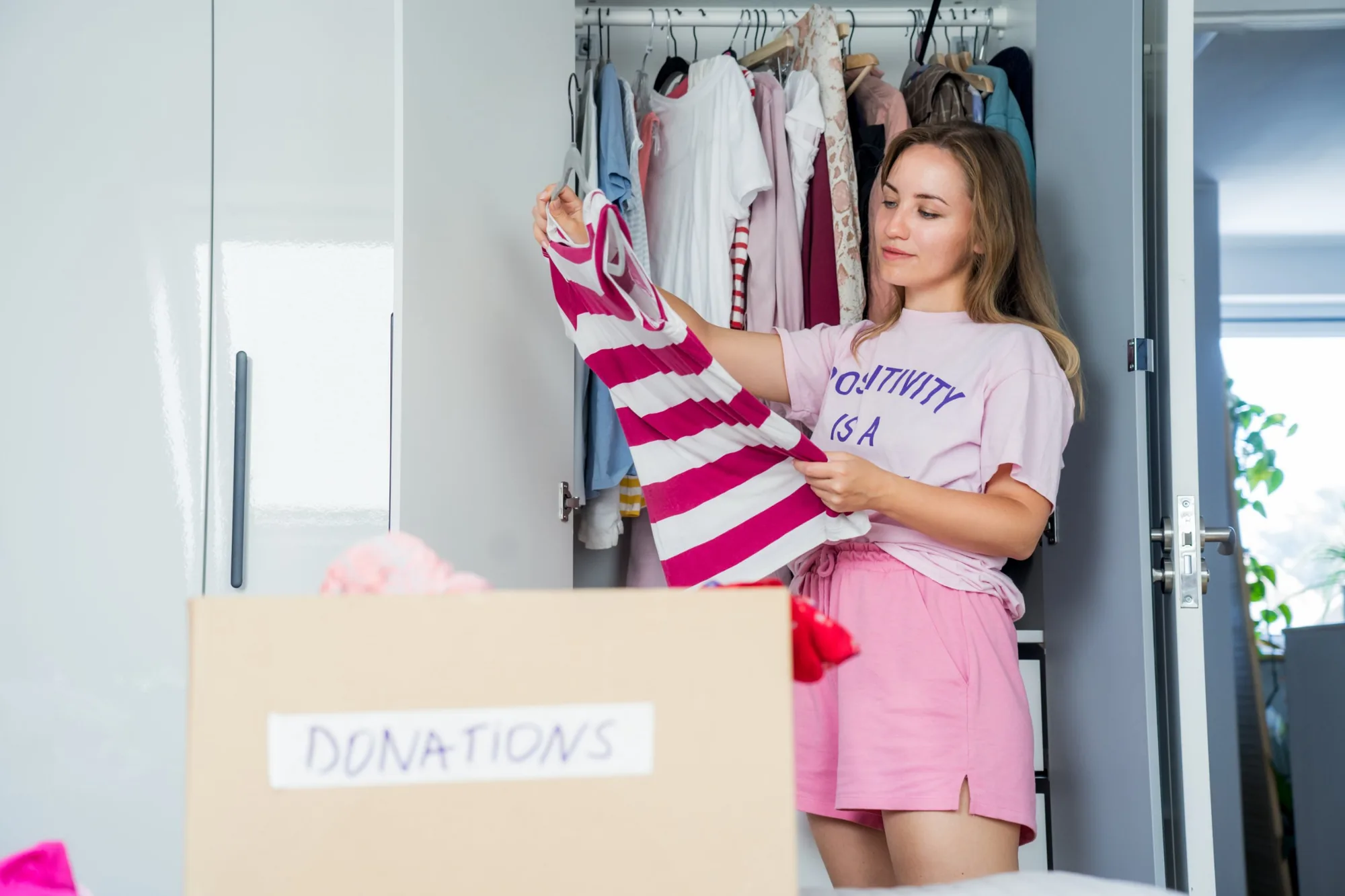
Sort by destination, not by sentiment. Sort everything into four piles in one pass through the closet.
- Resale: This pile should include modern, clean and undamaged items, and the kind of thing a consignment shop or resale app lists in its own search. Photograph it the same day, or it goes to pile two.
- Donation: Collect clean and wearable items with no stains, rips or missing hardware. This is the pile thrift stores can actually put on a rack. Fold it and bag it dry.
- Textile recycling: Include stained, torn and stretched items, single socks, worn-out sheets and towels. Clean and dry is the only standard; MassDEP's rule of thumb is that virtually any textile can be reused or recycled if it is clean and dry. Use a textile recycling bin or a retailer take-back program, not the thrift store donation door.
- Trash: Toss only what is moldy, oil-soaked or otherwise contaminated. That is the same exemption Massachusetts wrote into its ban, and it is a short list.
Two habits keep the piles honest. Count duplicates before deciding: six black T-shirts are usually two keepers and four resale or donation candidates. And empty the closet by section rather than all at once, so the floor never holds more than one day's sorting. The reward shows up at the thrift store, where a bag that is all wearable gets racked instead of baled.
This story was produced by Closets by Design and reviewed and distributed by Stacker.